Local Community College CEOs Participate in Panel Discussion at ACBO Conference
SAN MARCOS (November 11, 2009)
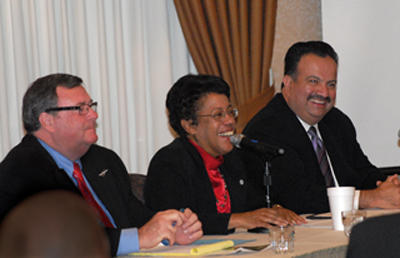 Chief Executive Officers (CEOs) from three local community college districts shared their thoughts recently in a panel discussion during the Association of Chief Business Officials (ACBO) Fall Conference at the Pala Mesa Resort in Fallbrook. Moderated by Bonnie Ann Dowd, Palomar College’s Assistant Superintendent/Vice President, Finance and Administrative Services, the session was titled, Examining the Relationship between the CEO and CBO (Chief Business Officer). Participating in the discussion were Constance Carroll, Chancellor of the San Diego Community College District, Robert P. Deegan, Superintendent/President, Palomar College District; and Francisco Rodriguez, Superintendent/President, MiraCosta Community College District. Approximately 135 people attended the conference session.
ACBO (Association of Chief Business Officials) is a statewide organization representing all of the community colleges in the state. The panel discussion was part of the organization’s Fall 2009 CBO conference, consisting of 2.5 days of workshops, including sessions dealing with various aspect of the CBO position e.g., construction, budget, legal and regulatory.
An ACBO Board member, Dowd represents San Diego and Imperial County community colleges in the organization, and was the conference chair for the event. She said that having the CEO panel as part of the conference was a first time event. The panelists responded to a series of questions posed by Dowd, covering such topics as:
 The challenges and opportunities California community college officials might face in California in the next couple of years; the specific role(s) CBOs play in addressing the challenges and opportunities system-wide and within each district; how the position of CBO has changed in recent years; the role a CBO plays in student success; the significance of the relationship between the CEO and the CBO; the skill sets necessary/ desirable for those seeking a CBO position; and what the ACBO organization might do to better support California Community Colleges.
Discussing the challenges of the next few years, Constance Carroll referred to “the big challenge” as the financial one, and how to maintain the high quality of education until the budget situation improves. She suggested that there will probably be some relief in 2011 or 2012, but dealing with the current situation, especially in California, is tricky. Carroll said that California community college officials must deal with a unique combination of three elements, a “triad,” consisting of a single source of funding which is currently deficient, an elected Board of Trustees, and collective bargaining. While the challenges will continue, she said, “…the opportunities for creative engineering are quite rich.”
Bob Deegan commented that it is important to keep in mind that “we are part of the solution; more and more students are turning to community colleges.” He pointed out that CEOs are looking to other CEOs and CBOs to re-examine how other colleges are operating, looking at alternative ways to better serve [under these circumstances].
Francisco Rodriguez discussed the importance of not disrupting collegial relations during these times. With the compounded effect of chronic underfunding and other challenges there can be an “erosion of trust” [among college officials] – it is important to “maintain and not fracture long-term relations.” During this time there needs to be “integrity of voice.” Rodriguez also pointed out that the strength of the College Foundation should be focused on, as the need for additional funding is increasing.
Each of the three panelists agreed that the role of the CBO is critical to successfully addressing the current challenges faced system-wide and within each district. Deegan described the Chief Financial Officer (CFO) as a “key person” who must understand not only the financial details, but enrollment management. Rodriguez said the CFO should be an example of civility – someone who can make calm out of crises, and who is able to develop key strategies.
When the discussion turned to the role of CBO in student success, Carroll used a financially healthy institution as a model, suggesting it is easier to provide good quality instruction when the budget is not deficient. She said that we need to come up with a [new] formula so that the quality we are providing students does not suffer. “We need to quantify what we mean –everyone has a role,” she said.
Each of the three agreed that the CBO plays an in important role in student success, and the more college administrators can work together, the more likely students will succeed. Deegan said that the CBO contributes to creating an environment for students that is “welcoming, nurturing and supportive.” Rodriguez added that the students benefit when the executive administration “is seen as a team.”
Rodriguez said that the “success of the CEO depends on the CBO”. Carroll and Deegan concurred. All agreed that the CEO/CBO relationship is a mutually dependent one. Carroll pointed out that there are three different aspects to the relationship – each important at different times: professional/administrative/political. The relationship is a partnership, should be based on knowledge and mutual respect. Each should know more about his or her own job than the other and advise the other as required. The CBO is the financial mentor. Balance and candor is necessary for the relationship to work effectively.
Deegan said it is of critical importance to have a trusted adviser relationship. If tough decisions are to be made, the CEO must know that the information the CBO provides is solid. During such times as when collective bargaining occurs, the CEO must be able to look to the CBO for information and advice, knowing that the information is as solid as possible. He also pointed out that it is important for CEOs and CBOs to enjoy and celebrate the good times, such as when the community passed Palomar’s 694 billion bond proposition with 58% approval from the voters; and when the first of those bonds were sold. He described the relationship as “key” and “critical,” …the CEO has to be able to trust the CBO and the trust goes both ways.
In discussing the skill sets that are desirable for those wanting to become CBOs, Carroll said that a candidate must be able to build relationships and credibility, incorporating such things as public forums on the budget.
Deegan said that someone interested in becoming a CBO needs to experience other areas of the college such as student services, etc. He applauded ACBO for encouraging others besides CBOs to attend the ACBO conference, and for offering training opportunities to those considering entering this field.
Rodriguez said that CFOs might make good CEOs. An effective CFO should be able to transmit confidence and integrity. In addition to knowing how to deal with and interpret numbers, a good candidate needs to perform well in public presentations, with the ability to present information clearly, succinctly and in a compelling manner. They must be able to at times “make good decisions based on imperfect [or incomplete] information.”
In a discussion of what ACBO can do to support colleges/districts, Carroll said that it is sometimes hard to know what others [in the system] are doing. ACBO could help by providing Best Practices updates and surveys, along with information about crisis intervention. Rodriguez said that because of the high rate of turnover in CEO/CFO positions, the organization could help with smoothing transitions/planning. Deegan said that continuing with the trainings, such as the ACBO Institute is very helpful.
Responding to audience members’ questions after the conclusion of the panel discussion, some of the points covered were:
Carroll shared some of the ways the San Diego Community College District is dealing with the deficit in funding, such as leasing surplus property to help close the budget gap; and working toward an exemption from the 50% law in order to maintain the cost for facilities. Carroll described the current situation as “a perfect storm,” with dwindling resources and no one wanting to give up anything. Deegan said he is trying to save jobs and be fair to constituent groups; when dealing with unions, he explains that “this is all [the funding] we have,” and he is open to any ideas for operating differently.
When an audience member asked how new CEOs might be mentored [by CBOs], Rodriguez pointed out that having a financial mentor is especially important in these times, as many new hires are from out-of-state and may not know how things work in California.
Carroll said that the central activity [for the CFO] is to frame issues strategically for the CEO, to provide a financial portrait, an ongoing class [to keep the CEO as knowledgeable as possible].